

Most people assume tracking works like a ride-hailing app, with a live location updating second by second. It doesn't. Your article gets scanned at a handful of points along its route, and those scans get uploaded in batches.
That single fact explains nearly every "why is it stuck?" panic. Here's the full picture, from the barcode on your slip to the moment the postman knocks.
What india post tracking actually shows you
India post tracking is a log of barcode scans, not a GPS feed. Each time your article reaches a checkpoint, a staff member scans the barcode and that event lands on your tracking page. Between scans, there's silence. The item is moving; the system just isn't watching it every minute.
So when you see nothing happening for a day, it usually means your article is in transit between two checkpoints, or sitting in a sealed bag that hasn't been opened yet. The same logic covers speed post tracking, registered post tracking, and ordinary parcels. The service changes; the scan-based mechanics don't.
The tracking number decoded
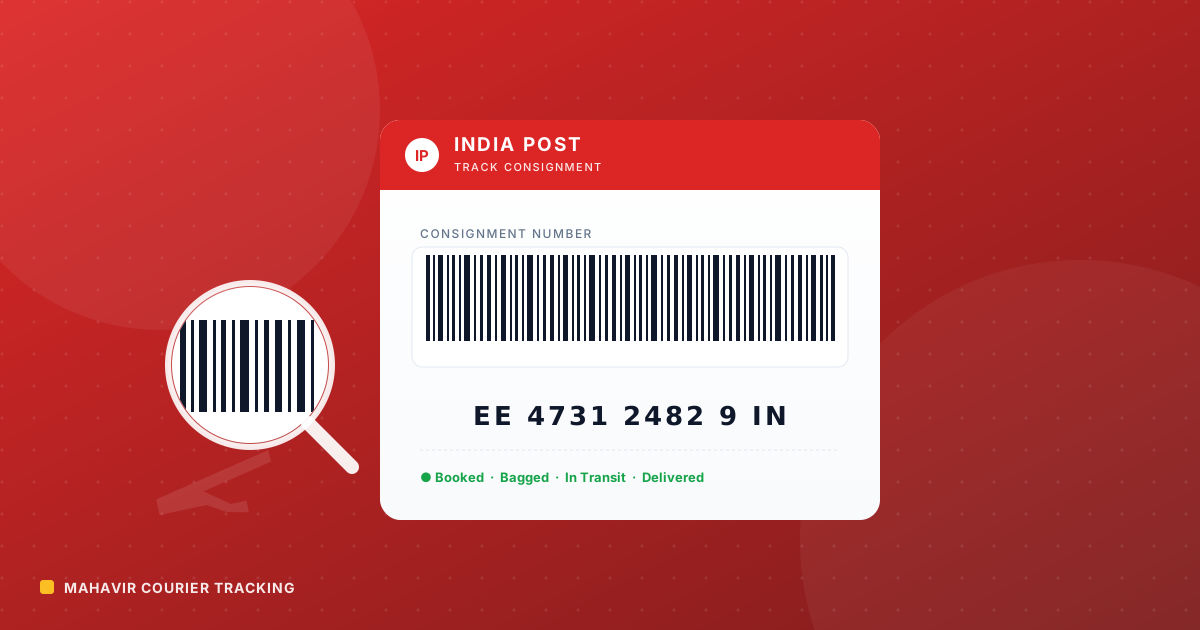
Your consignment number follows the UPU S10 standard, used by postal services worldwide. It's 13 characters: two letters, an eight-digit serial, a single check digit, and a two-letter country code. Take EE473124829IN. The EE is the service indicator (Speed Post), 47312482 is the serial, 9 is a check digit, and IN is the origin country, India.
That trailing IN trips people up. It marks where the item was booked, not where it's going. An inbound international parcel ends in the sender's country code, so you'll see US, CN, KR, or GB on those. The check digit isn't decoration either; it's calculated from the serial (weights 8,6,4,2,3,5,9,7), so a mistyped number usually fails the math. The barcode on your slip encodes this exact 13-character value.
Common service prefixes
- EE / EU / EX — domestic Speed Post (Express)
- EM / EA — international EMS
- RX / RA / RP / RR — Registered Post
- CP / CE — Parcel
One myth worth killing: the second letter does not tell you the origin state. There's no official India Post state-to-letter mapping. If a website claims your second letter reveals "Gujarat" or "Bihar", ignore it.
The journey, and why "Item Bagged" can sit for days
A tracked article passes through a fixed chain of scans: booking, dispatch, carried between hubs, received and sorted at a National Sorting Hub, dispatched onward, received at the delivery post office, out for delivery, and finally delivered. Of these nine events, seven happen at the item level and two happen at the bag level inside the hub.
That bag detail is the key to "Item Bagged". When your article shows that status, it's been sealed into a mail bag, a receptacle, along with dozens of other items heading the same direction. From then on, the bag travels and gets handled, but your individual item isn't scanned again until the bag is opened at the next hub. So the page can sit unchanged for a day or two while your envelope is very much on the road.
India Post routes mail hub-and-spoke style, sorting mainly on the first three digits of the destination PIN. The first digit is the region, the second a sub-zone, the third the sorting district, and the last three pick the delivery post office. A Speed Post envelope from Surat to Patna gets bagged in Surat, rides to a sorting hub, then onward toward Patna's PIN before the bag is finally split for the local office.
India post tracking status meanings
The wording on the page is terse and a bit institutional. Here's what each common entry is actually telling you.
India post tracking status, translated
- Item Booked — accepted at the counter; your number is now live
- Item Bagged — sealed into a mail bag with other items
- Despatch from X — the bag has left by road, rail, or air
- Item Received at / Arrival at X — the bag was re-scanned at a hub or office
- Item Redirected — rerouted to a corrected address or office, not lost
- Out for Delivery — it's with the postman today
- Item Delivered — handed over (signed for, in registered post)
- Returned / Undelivered — sent back after the retention window
Notice how several of these describe the bag, not your item. That's deliberate, and it's why entries can appear in clumps rather than a smooth trickle.
Tracking not updating? When to actually worry
Scans happen only at fixed checkpoints, and they upload in batches rather than the instant they're taken. A 24 to 48 hour gap is routine; on long interstate or rural routes it can stretch to one to three days. You'll often refresh after a quiet spell and find the page has jumped several entries at once, which is just a bag being opened and its contents scanned together.
Before assuming something's gone wrong, check it against the normal delivery windows for the service.
Typical delivery windows
- Metro / local: 1-3 days
- Same state: 2-5 days
- Interstate: 2-7 business days
- Remote / rural: 5-10 days
The rough rule: escalate only after about 7 to 10 working days, and only once you're also past the expected window for that route. At that point, contact the booking office or the delivery post office with your consignment number. Before that, a still page is almost always just the gap between scans.
Where and how to check india post tracking
Stick to India Post's own channels for the real status. The official site is indiapost.gov.in, where you paste your number into the tracking box. You can also SMS POST TRACK <number> to 166 or 51969 and get the latest status by reply, handy when you're offline or on a basic phone. The official Dak Sewa 2.0 app, which replaced Postinfo in October 2025, does the same with a cleaner interface. Numbers stay trackable for 60 days after booking, so save older slips if you might need them.
If you want a quick lookup without opening the government portal, a convenient third-party page like India post tracking can pull the same status for you. Treat it as a convenience, though, not an official source; the authoritative record always lives with India Post itself.
India Post Tracking: Frequently Asked Questions
Does the trailing IN in my tracking number mean it's coming to India? No. The two-letter country code at the end marks the origin, where the item was booked. IN means it was posted in India. An item sent to you from abroad ends in the sender's country code, such as US or CN.
My tracking has said "Item Bagged" for two days. Is it lost? Almost certainly not. Once an item is bagged, the sealed bag travels and your individual article isn't scanned again until that bag is opened at the next hub. A still status for a day or two during transit is completely normal.
What's the difference between Speed Post and Registered Post tracking? Both are tracked through the same scan system. Speed Post (launched August 1986) is the faster express service with EE/EU/EX prefixes. Registered Post is slower and cheaper, carries an R-prefix, and is delivered against a signed acknowledgement, useful for documents like an Aadhaar card.
India post tracking isn't a live map, and that's fine once you know how to read it. Decode the number, understand that the bag travels while the item rides quietly inside it, and give long routes their honest 7 to 10 days before raising an alarm. Check only through India Post's own channels, ignore the second-letter myth and the phishing texts, and most of the waiting stops feeling like a mystery.